
“It’s bad luck to be superstitious.” – Andrew W. Mathis
Why We Knock on Wood and Fear Black Cats.
Superstitions have been a part of human culture for millennia, acting as a bridge between uncertainty and comfort. Before science could explain why the sun rises or why crops fail, people turned to supernatural beliefs to make sense of the world. Over time, these beliefs evolved, shaping traditions, influencing behaviors, and sometimes making their way into our modern lives—even if we no longer believe in their original meaning.
From ancient omens to lucky numbers, let’s take a journey through the fascinating history of superstitions across different cultures and see how they have changed over time.
Ancient Origins: When the Gods Held All the Answers
Superstitions likely began when early humans noticed patterns in nature. A good hunt followed by a certain ritual? That ritual must bring luck. A bad storm after breaking a rule? The gods must be angry.
Egypt: Protecting the Afterlife

The ancient Egyptians were meticulous when it came to the afterlife, and many of their superstitions revolved around ensuring a smooth passage to the next world. Black cats, for instance, were not unlucky at all but rather revered as sacred animals linked to the goddess Bastet. Killing one was believed to bring misfortune, a belief so strong that even in later centuries, Egyptian armies would surrender rather than risk harming a cat.
The practice of placing scarab beetle amulets on the deceased also had a purpose—it was meant to provide protection and ensure rebirth, much like a cosmic security pass to the underworld.
Greece & Rome: Reading the Signs
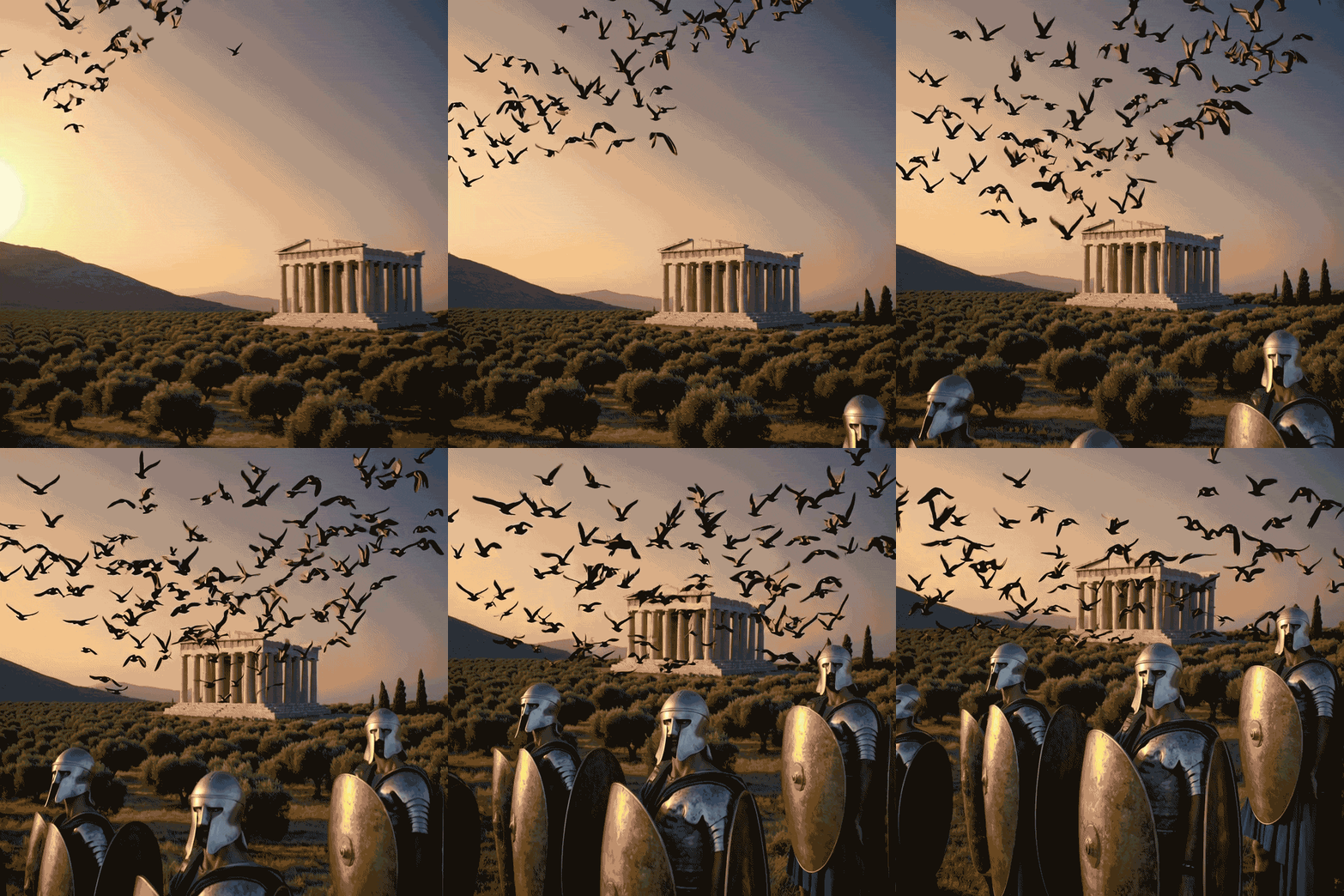
The Greeks and Romans were deeply superstitious, believing in omens and divine intervention. Birds were often seen as messengers from the gods, and their behavior could determine everything from battle strategies to personal decisions.
The Romans also gave us one of today’s most enduring superstitions: knocking on wood. They believed that trees housed spirits, and touching the wood would either summon their protection or prevent them from overhearing and jinxing good fortune.
Superstitions in the Middle Ages: Fear and Folklore
The medieval period saw an explosion of superstitions, largely driven by religious beliefs and a deep fear of the unknown.
Europe: Witches, Mirrors, and the Number 13
The fear of black cats as omens of misfortune arose during the medieval witch hunts, when cats were thought to be witches’ familiars. If a black cat crossed your path, it was considered a sign that a witch was nearby—or worse, that the devil himself had taken an interest in you.
The superstition about breaking a mirror bringing seven years of bad luck stems from the belief that mirrors reflected a part of the soul. Damaging a mirror was thought to harm the soul, leading to misfortune until it could be renewed—a process believed to take seven years.
The fear of the number 13 also gained traction during this period. Some trace it back to the Last Supper, where Judas, the betrayer, was the 13th guest. Others point to Norse mythology, where Loki, the trickster god, was the uninvited 13th guest at a feast, leading to chaos. Today, many buildings still skip the 13th floor, and Friday the 13th is widely considered an unlucky day
Superstitions Around the World
Different cultures developed their own unique superstitions, often shaped by local traditions, languages, and religious beliefs.
China: Numbers and Ghosts
Numbers play a significant role in Chinese superstitions. The number 4 (四, sì) is considered unlucky because it sounds like the word for “death” (死, sǐ). Many buildings skip the fourth floor, much like Western buildings avoid the 13th. On the other hand, 8 (八, bā) is seen as extremely lucky because it sounds like “prosper” (发, fā). This is why phone numbers, addresses, and even wedding dates with the number 8 are highly sought after.
Another common superstition is not whistling at night, as it is believed to attract ghosts. Traditional folklore suggests that spirits roam more freely after dark, and whistling might be an open invitation for unwanted company
Japan: Chopsticks and Sleeping Positions
In Japan, placing chopsticks upright in a bowl of rice is considered bad luck because it resembles the way rice is offered to the deceased at funerals. Similarly, sleeping with your head facing north is avoided, as this is how the dead are positioned for burial.
A more lighthearted superstition involves dreams—if you dream of Mount Fuji, a hawk, or an eggplant on New Year’s Day, it is said to bring good luck for the year ahead. While the exact origin is unclear, these symbols are thought to represent ambition, strength, and prosperity.
India: The Left Hand and Falling Lizards
n Indian culture, using the left hand for important tasks such as giving money or eating is discouraged, as it is traditionally associated with impurity.
A more interesting superstition involves lizards—if one falls on you, the exact spot it lands determines whether good or bad luck is coming your way. Some people even consult lizard astrology charts to interpret the omen.

Superstitions in the Modern World
Even in an age of science and technology, superstitions persist. They may have lost their original meanings, but they remain a part of daily life in subtle ways.

- Athletes have rituals: Many sports stars swear by lucky socks, pre-game routines, or wearing the same jersey for good luck.
- Theater actors avoid saying “Macbeth” inside a theater, calling it “The Scottish Play” instead, due to its long history of being associated with mishaps.
- Stock traders and gamblers have lucky charms, believing in lucky numbers or patterns despite the randomness of their trades.
Even those who don’t consider themselves superstitious often hesitate before walking under a ladder or feel compelled to toss spilled salt over their shoulder—just in case.
Are We Ever Letting Go?
Superstitions have evolved alongside human civilization, adapting to new cultures and technologies while retaining their core purpose: offering a sense of control over uncertainty.
Whether it’s an ancient Greek reading the flight of birds, a medieval European fearing broken mirrors, or a modern traveler avoiding seat 13 on a plane, these beliefs remind us that, deep down, humans are wired to look for patterns—even in the most unexpected places.
And if you just spilled some salt while reading this? 🧂 Well, you know what to do—toss it over your left shoulder! 😉 Just in case. 🍀
References
- Further Reading & Sources
- “The Origins of Superstitions” – National Geographic
- “The Psychology of Superstitions” – Scientific American
- “Cultural Superstitions Around the World” – BBC Culture
- “Ancient Rituals and Omens” – Smithsonian Magazine
 BACK WHEN WE